Constructors
constructor
-
new GlyphString(
properties?: Partial<
{ glyphs: GlyphInfo[]; log_clusters: number; num_glyphs: number },
>,
): GlyphStringParameters
Optionalproperties: Partial<{ glyphs: GlyphInfo[]; log_clusters: number; num_glyphs: number }>
Returns GlyphString
Methods
copy
-
Copy a glyph string and associated storage.
Returns GlyphString
the newly allocated Pango.GlyphString
extents


extents_
free
-
Free a glyph string and associated storage.
Returns void
get_
-
Given a Pango.GlyphString and corresponding text, determine the width corresponding to each character.
When multiple characters compose a single cluster, the width of the entire cluster is divided equally among the characters.
See also Pango.GlyphItem.get_logical_widths.
Parameters
- text: string
the text corresponding to the glyphs
- length: number
the length of
text, in bytes - embedding_level: number
the embedding level of the string
Returns number[]
- text: string
Since 1.14get_
-
Computes the logical width of the glyph string.
This can also be computed using Pango.GlyphString.extents. However, since this only computes the width, it's much faster. This is in fact only a convenience function that computes the sum of
geometry.width for each glyph in theglyphs.Returns number
the logical width of the glyph string.
index_
-
index_to_x(
text: string,
length: number,
analysis: Analysis,
index_: number,
trailing: boolean,
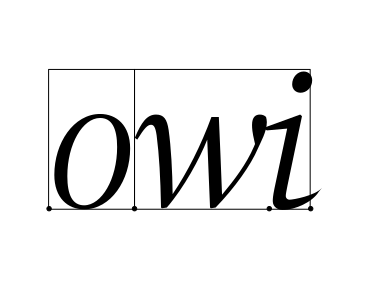
): numberConverts from character position to x position.
The X position is measured from the left edge of the run. Character positions are obtained using font metrics for ligatures where available, and computed by dividing up each cluster into equal portions, otherwise.
Parameters
- text: string
the text for the run
- length: number
the number of bytes (not characters) in
text. - analysis: Analysis
the analysis information return from itemize
- index_: number
the byte index within
text - trailing: boolean
whether we should compute the result for the beginning (
false) or end (true) of the character.
Returns number
- text: string

Since 1.50index_
-
index_to_x_full(
text: string,
length: number,
analysis: Analysis,
attrs: LogAttr,
index_: number,
trailing: boolean,
): numberConverts from character position to x position.
This variant of Pango.GlyphString.index_to_x additionally accepts a Pango.LogAttr array. The grapheme boundary information in it can be used to disambiguate positioning inside some complex clusters.
Parameters
- text: string
the text for the run
- length: number
the number of bytes (not characters) in
text. - analysis: Analysis
the analysis information return from itemize
- attrs: LogAttr
Pango.LogAttr array for
text - index_: number
the byte index within
text - trailing: boolean
whether we should compute the result for the beginning (
false) or end (true) of the character.
Returns number
- text: string
set_
-
Resize a glyph string to the given length.
Parameters
- new_len: number
the new length of the string
Returns void
- new_len: number
x_
-
Convert from x offset to character position.
Character positions are computed by dividing up each cluster into equal portions. In scripts where positioning within a cluster is not allowed (such as Thai), the returned value may not be a valid cursor position; the caller must combine the result with the logical attributes for the text to compute the valid cursor position.
Parameters
Returns [number, number]
Staticnew
-
Returns GlyphString
A Pango.GlyphString is used to store strings of glyphs with geometry and visual attribute information.
The storage for the glyph information is owned by the structure which simplifies memory management.