Methods
Since 4.14compare
-
Returns whether
point1is before or afterpoint2.Parameters
- point2: PathPoint
another path point
Returns number
-1 if
point1is beforepoint2, 1 ifpoint1is afterpoint2, 0 if they are equal - point2: PathPoint
Since 4.14copy
Since 4.14equal
-
Returns whether the two path points refer to the same location on all paths.
Note that the start- and endpoint of a closed contour will compare nonequal according to this definition. Use Gsk.Path.is_closed to find out if the start- and endpoint of a concrete path refer to the same location.
Parameters
- point2: PathPoint
another path point
Returns boolean
true if
point1andpoint2are equal - point2: PathPoint
Since 4.14free
Since 4.14get_
-
Calculates the curvature of the path at the point.
Optionally, returns the center of the osculating circle as well. The curvature is the inverse of the radius of the osculating circle.
Lines have a curvature of zero (indicating an osculating circle of infinite radius). In this case, the
centeris not modified.Circles with a radius of zero have
INFINITYas curvatureNote that certain points on a path may not have a single curvature, such as sharp turns. At such points, there are two curvatures — the (limit of) the curvature of the path going into the point, and the (limit of) the curvature of the path coming out of it. The
directionargument lets you choose which one to get.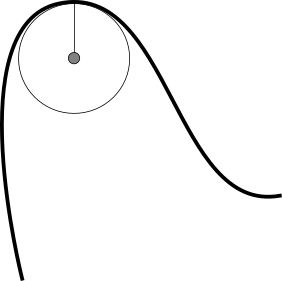
Parameters
- path: Gsk.Path
the path that
pointis on - direction: Gsk.PathDirection
the direction for which to return the curvature
Returns [number, Graphene.Point]
the curvature of the path at the given point
- path: Gsk.Path

Since 4.14get_
-
Returns the distance from the beginning of the path to the point.
Parameters
- measure: PathMeasure
a path measure for the path
Returns number
the distance of
point - measure: PathMeasure
Since 4.14get_
Since 4.14get_
-
Gets the direction of the tangent at a given point.
This is a convenience variant of Gsk.PathPoint.get_tangent that returns the angle between the tangent and the X axis. The angle can e.g. be used in gtk_snapshot_rotate().
Parameters
- path: Gsk.Path
the path that
pointis on - direction: Gsk.PathDirection
the direction for which to return the rotation
Returns number
the angle between the tangent and the X axis, in degrees
- path: Gsk.Path
Since 4.14get_
-
Gets the tangent of the path at the point.
Note that certain points on a path may not have a single tangent, such as sharp turns. At such points, there are two tangents — the direction of the path going into the point, and the direction coming out of it. The
directionargument lets you choose which one to get.If the path is just a single point (e.g. a circle with radius zero), then the tangent is set to
0, 0.If you want to orient something in the direction of the path, Gsk.PathPoint.get_rotation may be more convenient to use.
Parameters
- path: Gsk.Path
the path that
pointis on - direction: Gsk.PathDirection
the direction for which to return the tangent
Returns Vec2
- path: Gsk.Path
Represents a point on a path.
It can be queried for properties of the path at that point, such as its tangent or its curvature.
To obtain a Gsk.PathPoint, use Gsk.Path.get_closest_point, Gsk.Path.get_start_point, Gsk.Path.get_end_point or Gsk.PathMeasure.get_point.
Note that Gsk.PathPoint structs are meant to be stack-allocated, and don't hold a reference to the path object they are obtained from. It is the callers responsibility to keep a reference to the path as long as the Gsk.PathPoint is used.
Since
4.14